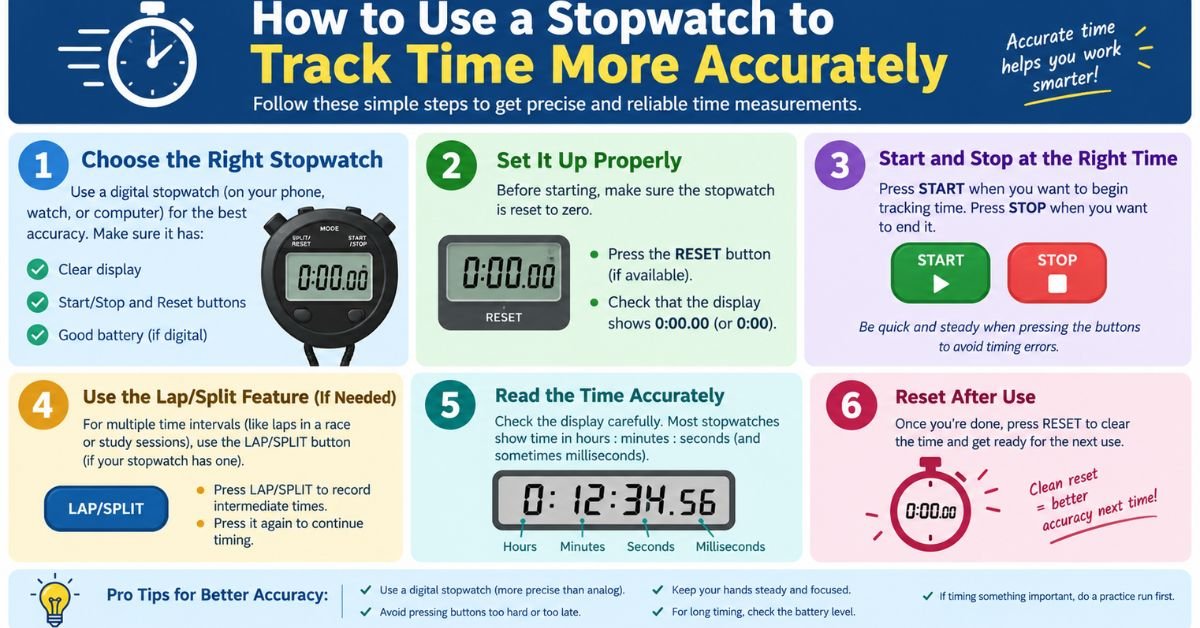
A stopwatch measures elapsed time from the moment you start it. Unlike a countdown timer, which counts down toward zero, a stopwatch counts upward and is useful when you want to find out how long something actually takes. You can use it to time a presentation, measure a practice round, compare repeated tasks, or understand where your time goes.
Countdown timer or stopwatch: which should you use?
Use a countdown timer when you already know how long you want to spend—for example, a 20-minute study block. Use a stopwatch when you want to measure the duration of an activity without deciding the end time in advance. TimerNest has both a countdown timer and an online stopwatch.
How to time an activity
- Prepare first. Open the stopwatch and make sure you know what event marks the start and finish.
- Start at the same point each time. Consistent start and stop rules make comparisons more meaningful.
- Keep the activity conditions similar. If you are comparing two attempts, try to keep the task and environment as consistent as practical.
- Stop when the defined activity ends. Record the result rather than relying on memory.
- Repeat when useful. One measurement can be unusual. Several attempts can reveal a more typical range.
What are lap times?
A lap records a split within a longer running stopwatch session, where supported. For example, you might record each practice round without resetting the overall timer. Splits help you see whether later rounds take longer or whether your pace changes. They are most useful when each split represents the same kind of activity.
Use stopwatch results to improve a routine
For a work task, time a few normal attempts and calculate a rough average. Use that estimate to plan future sessions, but allow for differences in task difficulty. For studying, the stopwatch can show how long a practice set takes; for a planned focus session, a study timer may be more suitable. If you prefer planned focus-and-break cycles, try the Pomodoro timer.
Common stopwatch timing errors
- Starting late or stopping early because the start and finish points were not defined.
- Comparing results from different conditions as if they were identical.
- Drawing a conclusion from one unusually fast or slow attempt.
- Using timing alone to judge quality; a faster result is not always a better result.
- Forgetting to write down the result and later mixing up attempts.
Frequently asked questions
Does a stopwatch count down?
No. A stopwatch normally counts upward from zero to show elapsed time. A countdown timer moves toward zero from a duration you set.
Can I use a stopwatch for workouts?
Yes, for measuring elapsed time or practice rounds. For repeated work and rest intervals, the workout interval timer is usually more convenient.
Why should I repeat a measurement?
Repeating an activity can help show normal variation and reduce the chance of basing a plan on an unusual attempt.
Choose a clear activity, time it consistently, and use the result as information—not as a judgment. Visit the online stopwatch to begin, or return to the TimerNest for more timing tools.