
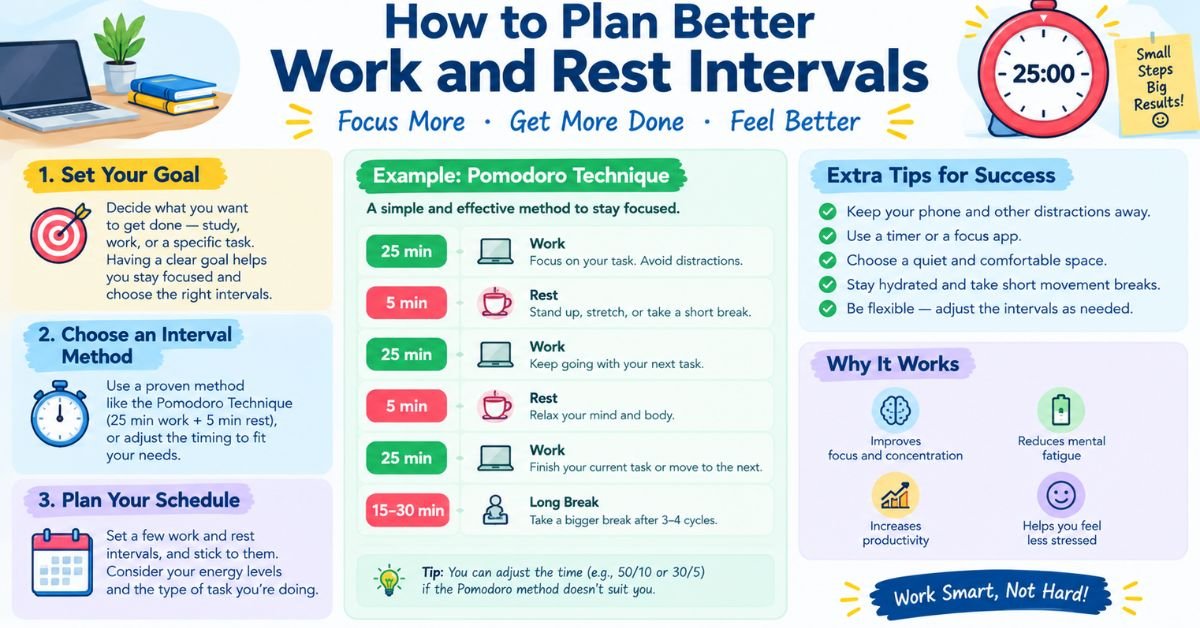
Work-and-rest intervals divide an activity into manageable periods. They can help you plan focused desk work, study practice, chores, or exercise. There is no single interval that works for everyone: the useful pattern depends on the activity, your experience, your energy, and whether you need uninterrupted time.
Define the goal of each interval
Before choosing a duration, decide what the work period is for. A study interval might mean answering a set of practice questions; a desk-work interval might mean drafting one section; an exercise interval might mean completing a movement at a controlled pace. A clear goal makes it easier to judge whether the interval is realistic.
Choose a manageable starting duration
For concentration tasks, you could experiment with 15–25 minutes and adjust based on how you feel and what you accomplish. Shorter blocks may be better for a difficult start, while complex work may need a longer uninterrupted period. Treat these as experiments, not universal rules.
Make breaks real breaks
Plan a pause before you are completely exhausted. During a desk-work break, stand, stretch gently, drink water, or rest your eyes. A break should help you return to the next interval, not become another demanding task. The Pomodoro focus timer can help organize focus periods and breaks.
Use different timing for different activities
For study, the study timer can structure revision blocks. For exercise, use the workout interval timer to keep track of planned work and rest periods. Physical intensity and recovery needs vary, so begin at a level appropriate for you and prioritize good technique over the clock.
Evaluate the pattern after a few sessions
Notice whether you can stay engaged, whether breaks are long enough, and whether the task is progressing. If you regularly stop before an interval ends, shorten it or clarify the task. If you finish early, use the remaining time for checking or preparation rather than adding busywork.
Errors to avoid
- Copying another person’s timing without considering your task.
- Skipping breaks to meet an arbitrary target.
- Making rest periods so short that you cannot recover.
- Using an interval timer as a substitute for safe exercise technique.
- Changing the timing after every single session instead of looking for a pattern.
Frequently asked questions
What is the best work-to-rest ratio?
It depends on the task. Mental work, strength training, and high-intensity exercise have different demands, so choose a pattern appropriate to the activity rather than one ratio for everything.
Should every work session be 25 minutes?
No. Twenty-five minutes is a common focus-session starting point, but shorter or longer blocks can be more suitable.
How can I keep track of a simple interval plan?
Write down the work duration, rest duration, number of rounds, and what counts as completion before starting. Then use the relevant timer tool.
Pick one activity, choose a realistic work interval and break, and review the results after a few rounds. Visit the workout timer or return to the TimerNest to find a timing tool for your next session.