
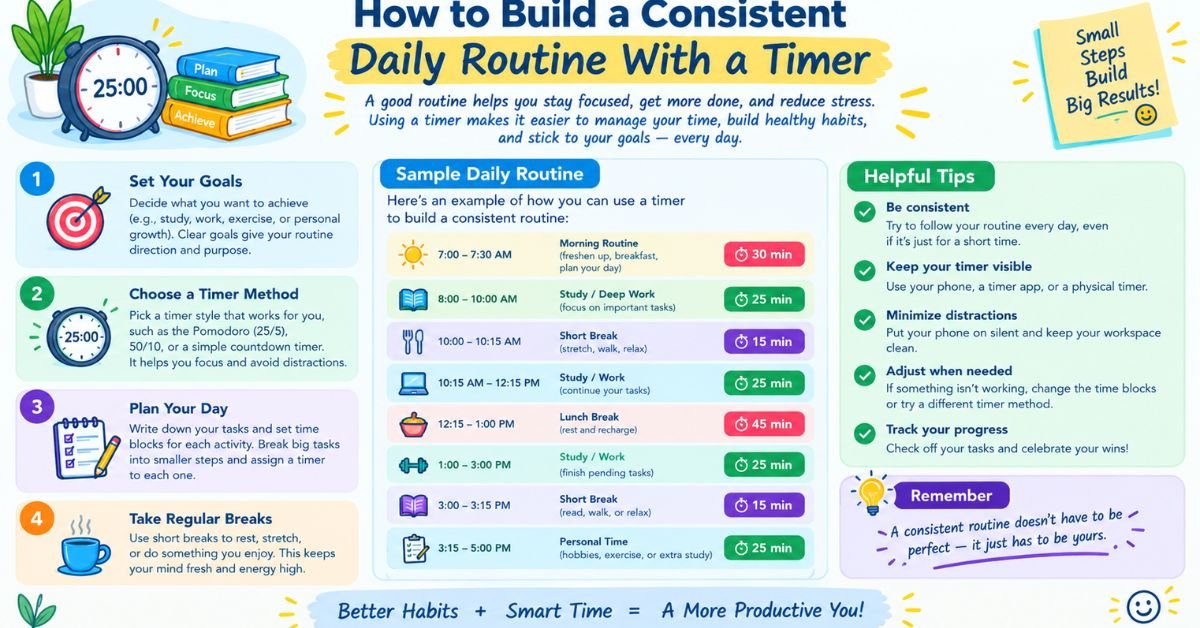
A daily routine is easier to follow when the next action is clear and the plan is realistic. A timer can help you begin a task, remember transitions, and avoid letting one activity consume the whole day. It is not about scheduling every minute; it is about giving important tasks a reasonable place in your day.
Start with a few anchors
Choose two or three repeatable points, such as a morning planning session, a focused work block, or an evening reset. Attach a simple action to each anchor. For example, spend five minutes reviewing priorities before opening email. Keep the routine small enough that you can repeat it on an ordinary busy day.
Estimate time instead of guessing
For a few days, use a stopwatch to measure how long recurring tasks actually take. Record a rough range rather than treating one result as exact. Then use a countdown timer to reserve time for similar tasks. Leave a buffer for interruptions and transitions.
Use time blocks that fit the task
Choose short blocks for quick tasks and longer blocks for work that needs concentration. A 10- or 15-minute block can be a manageable start when motivation is low. For study or writing, try a focus-and-break pattern using the Pomodoro focus timer, adjusting the interval to your needs.
Make transitions visible
Set a timer to remind you when to wrap up, save your work, or prepare for the next activity. Treat the alert as a cue to check progress, not an order to abandon something important mid-step. If a task needs more time, consciously move the next block instead of letting the schedule drift without noticing.
Review and adjust once a day
At the end of the day, ask: What worked? What consistently took longer than expected? Which task should be smaller tomorrow? Keep changes modest. A routine should support your life rather than make every unexpected event feel like failure.
Common routine-planning mistakes
- Planning every minute with no room for meals, travel, or interruptions.
- Giving difficult tasks unrealistic time limits.
- Using too many timers for activities that do not need them.
- Keeping a schedule that no longer matches your responsibilities.
- Judging success only by speed rather than completion and quality.
Frequently asked questions
How many timed blocks should I plan each day?
Start with a few important blocks and add more only if they genuinely help. The right number depends on your responsibilities and how predictable your day is.
Should I use the same schedule every day?
Keep helpful anchors consistent, but allow the rest to change with your workload, energy, and commitments.
What if I miss a timer or block?
Reset calmly. Decide whether to shorten, move, or drop the task, then continue with the next useful action.
Start small: choose one routine anchor and time it for a few days. Explore the countdown timer or visit the TimerNest homepage to choose a tool that fits your routine.